Thursday, December 20, 2018

Christmas & New Year’s Video: The gifts of God for the people of God


Let us make 2019 “The Year of Civility”
Hello, I’m Bishop Peggy Johnson, of the Eastern Pennsylvania and the Peninsula-Delaware Conferences of The United Methodist Church.

I bid you grace and peace in the name of the Lord Jesus Christ.  I celebrate with you this special time of the year: Advent, Christmas and the New Year: 2019.  May your churches and homes be filled with peace.

As we look to the Scriptures, I am reminded of the words of the Apostle Paul taken from II Timothy 1:7 where he writes “God has not given us a spirit of fear.”

There is a lot of trouble happening around this world right now: natural disasters, wars, rumors of war, trouble at our border, with years of immigration concern.  There is a lot of fearful talk as well.

But God has not given us a spirit of fear.  Fear is never from God. Fear can be summed up as “False Evidence Appearing Real.”  That popular acronym reminds us that we should never fear.

God does not give us fear; but God has other, better gifts to share with us. At this time of the year we are doing some Christmas shopping and buying material gifts. However, the gifts of God are spiritual, and those gifts last forever.  Here are some of God’s gifts:

1) Power

The power of God comes from the Holy Spirit that helps us overcome difficult circumstances.  The Spirit gives us faith and strength in times of need. Also, the Spirit endows each of us with unique talents for mission and ministry, so that we all have parts to play in building up the Body of Christ.

2) Love

Perfect love casts out fear.  God’s gift of love is Jesus Christ, who was born among us long ago.  He was God’s love incarnate, but he also came to die for our salvation. His love was sacrificial, and that kind of love never fails.  The love of Jesus is available to all of us.

3) Self-Control

Self-Control is so important.  It is especially critical how you control the way you talk.  There is a lot of negative rhetoric and fearful talk going around these days.

I would like to proclaim that the year 2019 be “The Year of Civility,” tempered by the power of God. God can help us control our tongues.

Remember: before you say something, ask yourself, “Is it true?” “Is it necessary?”  “Is it kind?” If it doesn’t pass these three tests, then don’t say it. And remember to practice saying positive things about your enemies.  Even a broken clock is right two times every day. The same is true of your worst enemy.

Power, Love and Self-Control. These are the gifts of God for the people of God to help us to overcome fear and life’s challenges.

I shall close with a poem by Horatius Bonar (1861)

O love that casts out fear,O love that casts out sin,O stay no more without,But come and dwell within.

True sunlight of the soul,
Surround us as we go.So shall our way be safe,Our feet no straying know.

Great love of God, come in!Thou Spring of everlasting peace,Thou living water come.Spring up in us and never cease.

Love of the living GodOf Father and of SonLove of the Holy Ghost,Make now our hearts as one.

Monday, December 17, 2018

A culturally competent Christmas carol


By Bishop Peggy Johnson
Of all the Christmas carols and hymns in the UM Hymnal none is as important for us today as #244, “’Twas in the Moon of Wintertime.”  It is a Huron Christmas carol originally written in the language of indigenous Canadian people in 1643 by a French Jesuit priest whose name was Jean de Brebeuf (1583-1649).
About 100 years after these words were written another priest, Father de Villeneuve, copied the words; and a native notary, Paul Picard, translated the poem into French. Still later, it was translated into English (1923) by Jesse Edgar Middelton, a Canadian newspaper reporter. The tune is a French Canadian melody known as “Une Jeune Pucelle.”  
The lyrics take the Christmas story and use symbols of the Huron culture in place of biblical words.  For example, “swaddling clothes” becomes “rabbit skin.” The wise men are “chiefs from far” who brought gifts of fox and beaver pelt.  
God is known as “Gitchi Manitou.” Images of the moon, snow, light, stars and wintertime paint the picture of Christmas as northern peoples would imagine it in their climate and landscape.  

A culturally competent priest

The writer of this hymn was a culturally competent priest who literally gave his life to share the gospel with the Huron/Wendat people.  Father Jean de Brebeuf showed a gift for languages as he studied for the priesthood. He naturally understood that to communicate with people from another culture he had to learn their language, customs and religious practices.  
So great was his rapport with the Huron people that they gave him the name “Echon,” and he was considered as one of them.  He wrote volumes about their language and culture in order to train the next generation of priests that would follow him in this work.  Because he took the time to understand the Huron people he was successful in teaching them about Jesus and raising up Christian believers.  
This is still how we do ministry today.  The world is very diverse and becoming more so with each passing year. The church needs to learn with humility and respect the culture and languages of people who are different from us for us to make disciples of all nations.  

Understanding ourselves better through diversity

We also learn and grow in our understanding of ourselves as we intentionally seek out diversity.  This is not easy, but it is clearly the vision of Pentecost when the Holy Spirit gave birth to a church of much cultural and linguistic variety.
Father Jean de Brebeuf also knew another thing about ministry: that one needs to be willing to sacrifice.  His first winter in Canada he spent the whole time in a freezing cold wigwam. He had to leave the area during the French and English wars but tenaciously came back to continue his ministry under threat of war.  
Many of the native peoples contracted European diseases, and he ministered to them during mass epidemics of illness and death.  The Jesuits went out on their missions expecting to die for the cause of Christ. And indeed, that was his sad fate. In 1649 he was kidnapped by the Iroquois (who were at war with the Huron people), and he was tortured and martyred.   Dietrich Bonhoeffer once said “When Christ calls a man, he bids him come and die.”

A cross to take up in our ministry

We would all prefer not to suffer.  But there is a cross in our ministry and a call for us to take up that cross every day.  There is a cross in evangelism and mission work.
In our Christmas story, when the baby Jesus was born, Mary laid him in a manger, a wooden feeding trough for animals. The cross of Calvary, where he would later die, was also made of wood.  
The message of Christmas is that God sent his son to the world out of God’s love for all people, all cultures and languages. He sent this son and savior so that through his death on the cross all might have access to forgiveness and to life abundant and everlasting.  There is pain in the offering, but great is the reward.
I hope you will sing this Christmas carol. But more important than that, I hope you will find ways to celebrate Christmastide this year with people from other cultures and languages. There is so much more we can be doing to spread this great good news to all people.
“Twas in the moon of wintertime, when all the birds had fled,
That mighty Gitchi Manitou sent angel choirs instead.
Before their light the stars grew dim, and wondering hunters heard the hymn,
Jesus your King is born, Jesus is born, in excelsis Gloria
O children of the forest free, O seed of Manitou,
The holy Child of earth and heaven is born today for you.
Come kneel before the radiant boy, who brings you beauty, peace and joy
Jesus your King is born, Jesus is born, in excelsis Gloria.

Sources:
  • Dietrich Bonhoeffer The Cost of Discipleship
  • “History of Hymns” “’Twas in the Moon of Wintertime” Discipleship Ministries   C. Michael Hawn
  • “Huron Carol” https://en.wikipedia.org/wiki/Huron_Carol
  • United Methodist Book of Hymns #244


Wednesday, November 21, 2018

Fulfilling our ministry ‘received in the Lord’


The Apostle Paul penned his letter to the Colossians as he sat in a prison cell.  People have a lot of time to think and pray while they are in prison.  Paul wrote inspiring words to edify and encourage early believers during his long periods of imprisonment.

His epistles typically end with a seres of personal greetings and admonitions. The letter to the Colossians is no exception.  But I was captured by Paul’s imperative words to Archippus: “See that you fulfill the ministry that you have received in the Lord.”

We don’t know much about Archippus. Paul was specifically calling him out in this letter, perhaps because he was procrastinating.  We believe that he did heed the Apostle’s words. Church tradition teaches that Archippus later became the first bishop of Laodicea in Phrygia and was martyred for the faith.

Paul’s words can be directed to all of us as well: “See that you fulfill the ministry that you have received in the Lord.”  Be it a church ministry or any service rendered anywhere for the Lord, your own unique call is a gift from God to be pursued and fulfilled.

This Sunday, November 25, churches will receive our annual United Methodist Student Day offering that enables many students to receive higher education and pursue their future careers in Christian leadership. Nothing could be more important for us as a church than to prepare our now and next generations of leaders.
Student Day offering scholarships are crucial
The scholarships your Student Day offerings provide are crucial to fulfilling the hopes and dreams—indeed, the call to serve—of countless college students. Many of them are seeking, striving to fulfill the ministry they have received in the Lord.

Please give generously to this special offering because it touches a future that is full of God’s faithful promises. And as you do, prayerfully consider the ministry that you have received from the Lord.
What do you need to pursue the ministry that you may have been putting off, like Archippus? May you find it and fulfill your call with true faithfulness. And please know this: God will equip you and stand by you always.

Tuesday, October 30, 2018

Quest for justice, mercy should be One Size Fits All

By Bishop Peggy Johnson

My son Gabriel appeared in a recent Facebook post donning a Halloween costume in which he is dressed as a cactus.  It is quite clever, and perhaps he chose this outfit because he works as a botanist at the Smithsonian Science Lab and loves plants. 

When I asked him about it, he said he purchased it at Walmart, and it is labeled “One Size Fits Most.” He said I could borrow it anytime I wanted to dress up like a cactus.  This is likely not going to happen. 

First, I don’t like plants all that much and secondly, “One Size Fits Most” never works for me. They are always too big. I can just imagine falling down steps in this unfitting cactus costume that my six-foot tall son fits into quite well.

Does one size fit most?  It is an important question to ponder as we consider our social issues in the world today. Is there a place for uniformity, or is it important to recognize our differences with respect and grace?  Yes and no.

When should ‘One Size Fit Most’?

The General Board of Church and Society is working on a revision of our United Methodist Social Principles. These can be found in our Book of Discipline in Paragraph 160-164.They include many important statements that we as United Methodists believe about social justice. However, one size does not always fit all in the global context.

Wednesday, October 10, 2018

Believing and being there for domestic violence victims

October is Domestic Violence & Intimate Partner Violence Prevention Month (Also known as National Domestic Violence Awareness Month)
By Bishop Peggy Johnson


She came to the United Methodist-sponsored DeafBlind Camp*, this young woman with a small child. Her husband dropped her off. She could neither see nor hear. But faithful volunteers interpreted for her, making tactile deaf signs in her hands. And they led her from place to place during the week of camp activities. 
I was running the camp; so I did not have much contact with “Audrey.”** The woman who served as her support service provider (SSP) sensed that she was burdened with something; but the nature of it was unclear.
Being deaf and blind comes with huge daily challenges. God bless this volunteer helper! After camp ended she went to visit “Audrey” at her home, and they formed a bond of friendship. 
It was through that bond that the terrible truth about Audrey’s husband came to light. He would beat her and kick her and put things in her way, so she would fall and hurt herself. This was unbelievable cruelty behind closed doors. 
Thanks to much intervention and support, the volunteer helped Audrey escape from this abusive environment, move out of the state (with her young child), endure divorce and custody court proceedings, and begin a new life. It all started with a relationship and the simple fact that the volunteer believed her story and then did something about it.

Wednesday, September 26, 2018

History Revisited

“Forget the former things;
do not dwell on the past.
See, I am doing a new thing!
Now it springs up; do you not perceive it?
I am making a way in the wilderness
and streams in the wasteland. (Isaiah 43:18-19, NIV)
Every October when I was in grade school we sang the same song: “In fourteen hundred and ninety-two, Columbus sailed the ocean blue.” I learned about this brave sailor, who challenged the thinking of the time that the earth was flat and if one went too far west they would fall off the map.

I marveled at his tenacity. When he could not get Italian supporters for his voyage, he went to King Ferdinand of Spain and his wife, Isabella. (I especially liked hearing about Isabella since most of my history lessons in school had very few women of prominence. Betsy Ross sewing a flag in Philadelphia was the only other woman I remember.)

I was taught that Columbus “discovered” the new world and brought Christ to the heathens. I actually wrote a newsletter once at my first parish saying that the name “Christopher” meant “Christ-bearer” and that he was spreading the faith to those who had never heard.

Then I went on a mission trip to the Dominican Republic and visited a large, modern museum of history, where I learned of Columbus’ brutality and the genocide of the indigenous Taino people. He instituted slavery and engaged in horrific acts of inhumanity.

According to an article in the Philadelphia Tribune (9/2/18), “Council Must Stop Celebrating Columbus Genocide,” by Michael Coard, “the atrocities of Columbus were so bad that Governor Francisco De Bodadilla arrested him for his many crimes and sent him back to Spain in shackles.” So much for my “Christ-bearer.”

Friday, September 14, 2018

Postcards from McAllen, Texas:  An Immersion in Immigration Realities

A tour provided by the General Board of Church and Society, Bishop Robert Schnase and support  personnel from the Rio Texas Annual Conference – August 22-24, 2018

By Bishop Peggy Johnson*


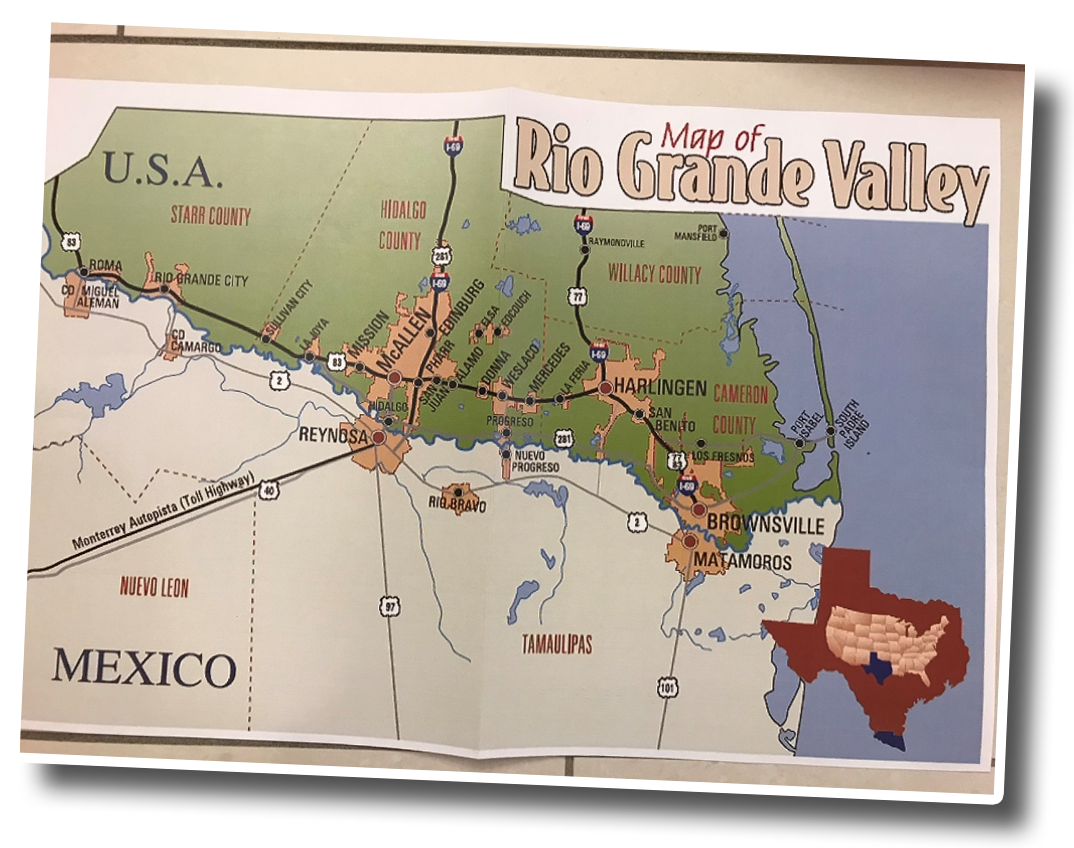
McAllen, Texas, is located in the Rio Grande Valley and it borders the country of Mexico. It is one of the poorest areas in the United States.  The average income is $34,000 and 29 percent of the people have no health care services.  This is a place where many people cross the border into the United States, and the dynamics of this are highly complex. United Methodists are found in this area, serving and ministering with the poor.


Bishop Robert Schnase, who serves in the Rio Texas Annual Conference, explained that the church strives to find safe places and spaces for migrating people to be processed and engaged, to offer compassion and civility, to build relationships, to teach people about the border experience and to be constantly in prayer. Radical hospitality is the always the goal.