Wednesday, May 26, 2021

Freedom Isn’t Free


Photo 69266331 © Paul Brady | Dreamstime.com


The CDC (Centers for Disease Control and Prevention) recently issued some long-awaited, almost unbelievable news: those who have been fully vaccinated can resume life normally without masks.

Of course, those who have not been vaccinated should continue to wear them. I have been asked to give updated recommendations for safety protocols for worship services and other gatherings in the wake of this new news. But this announcement from the CDC has made things easier and harder at the same time. This new freedom is spurring mixed reactions and new things to consider.


It reminds me of a song I heard years ago. Many of my friends in high school joined a singing group known as “Up with People.” They toured the country performing a number of positive songs about the future and the importance of world peace. One of their signature songs was, “Freedom Isn’t Free.” (Written by Paul and Ralph Colwell). I still remember the chorus:


“Freedom isn’t free. Freedom isn’t free. You’ve got to pay the price, you’ve got to sacrifice, for your liberty.”


This was the era of the Viet Nam War, after our many of fathers, brothers and other relatives had fought in World War II and the Korean War. The yearning for peace was on our hearts back then, just as it is now.


Remember those who sacrificed for freedom


Indeed, as we approach Memorial Day, May 31, we know that freedom for any nation is maintained at the cost of countless lives given by service men and women in armed conflict. There is a price and a sacrifice that we honor with grateful hearts. Other kinds of freedom also have a cost. The Apostle Paul wrote to the Galatians, “It is for freedom that Christ has set us free. Stand firm then, and do not let yourselves be burdened again by a yoke of slavery.” (Galatians 5:1) Freedom from sin, gained through Christ Jesus, requires a commitment to stand firm in the face of temptation.  


In his first letter to the church in Corinth, Paul admonishes them, “But take care that this freedom of yours does not somehow become a stumbling block to the weak.” (1 Corinthians 8:9). In this case he refers to Christians who are eating meat sacrificed to idols, which is perfectly alright in Paul’s eyes. But he is quick to remind the early church that some Christians are offended by this.


The caution is that we should not create problems for those who are more sensitive to this practice by freely and carelessly eating in front of them. The greater goal is not to hurt anyone.


Prioritize love, respect to preserve unity 


The price is to curb one’s expression of freedom out of respect for others. We do this out of love for Christ, in order to preserve the unity of the body.


While the COVID-19 pandemic is waning, it is not yet over. When it comes to wearing protective masks, there are people who prefer to wear them in church to feel safer—vaccinated or not. If that is the case, would it not be best to observe more caution, so that they feel more comfortable? Each church needs to work out its own plans, but love and respect for everyone should always be your ultimate aim.


One more thing: even with these new guidelines from the CDC for those who have been vaccinated, the world is not free from this deadly disease. It is still ravaging many countries on this globe even as I write these words. Is it not true that until all are free, none of us is truly free?


We are one family of humanity, and what affects one affects us all. That is certainly true when it comes to the reach of international travel. And if we believe we are all God’s family, then it is most especially true.


In that spirit, let us freely sacrifice for others in order to hasten the day of full freedom from COVID. Let us give generously of our means to support the efforts of the United Methodist Board of Global Ministries and the UM Committee on Relief (UMCOR). Still engaged in an ongoing, global response to COVID-19, they have sent $110,000 to our mission partners in India to provide relief for those who have lost income due to the pandemic. They have also provided funds for the purchase of medical equipment, ventilators, hospital beds and hygiene.


UMCOR’s COVID -19 response includes ongoing support of essential health services throughout the UMC health providers network and support of communities affected by the grave burdens of this disease.


You can help provide freedom by donating to the UMCOR COVID-19 Response Fund (Advance #3022612). Send your donations to our Conference office or mail them to Global Ministries/UMCOR, 458 Ponce De Leon Avenue, NEJ, Atlanta, GA 30308. Or give online at https://umcmission.org/advance-project/3022612/.

Freedom isn’t free. Protect it and help all to find freedom by sharing with them your respect and loving sacrifice. The greatest freedom of all is in Christ Jesus, our paramount model of loving, caring sacrifice. “So if the Son sets you free, you will be free indeed.” (John 8:36).

Resources: 

Tuesday, May 18, 2021

Pentecost: Come, Holy Spirit!


When I arrived on the campus of Asbury Theological Seminary in Wilmore, Kentucky, in the fall of 1977 to begin my Master of Divinity degree, one of the first things I was asked was, “Have you heard about the revival of 1970?” I had not.

The word “revival” was not something I had been familiar with growing up in a middle-class Methodist Church (not yet “United” Methodist), in a suburb of Baltimore, Maryland. I had a vague idea that it was some weeklong event in which a church invited a preacher to come and “revive” a complacent congregation. But I had never attended one.


It wasn’t long before I was duly instructed about the famous “Asbury Revival.” On February 3, 1970, in the Hughes Auditorium at Asbury College (the undergraduate school across the street from the seminary), a powerful movement of the Holy Spirit broke out during a regular morning chapel service. Non-stop prayer and an outpouring of spiritual gifts took control for 185 hours.

Classes were canceled and students and faculty devoted themselves to prayer and fasting. From that fervent prayer revival came amazing testimonies of commitments to Christ, confessions of sin, miracles of healing, broken marriages restored, and calls into ministry and the mission field.

Newspapers and TV stations across the country flocked to the tiny town of Wilmore to cover this phenomenon. Prayer requests poured in by telegram and telephone. Local church attendees, seminary students and curious neighbors packed the Hughes Auditorium to experience this supernatural presence of the Holy Spirit. It was described by one observer as “a weight of glory covering the campus.”

The will to seek God with all our hearts

Surely, we long for that today, and from time to time we experience these kinds of extraordinary signs of God’s Spirit on the move. There could be more of it if we just had the will to seek God with all of our hearts.

When we pray “Come, Holy Spirit,” as we do every year during our annual observance of Pentecost, do we know what we are asking? As the saying goes, “Be careful what you pray for.”

Praying for the movement of the Spirit involves commitment on our part and a willingness to radically shake up our “business as usual” forms of worship and practices of holiness. It isn’t about God coming down and fixing things for us. It is about humbly submitting to being changed and turned around. And yes, it is about sacrificing some of our comfortable ways of keeping God in a safe little box on the shelf of our hearts.


First and foremost, it requires an enormous amount of committed prayer and attention to the disciplines of our faith.

What happens when God shows up

When God shows up, as was seen at Asbury College and on the Day of Pentecost as recorded in the Book of Acts, chapter 2, this is what we will experience:

1) Confession – When confronted with the presence of God in the temple the prophet Isaiah declared, “I am lost, I am a man of unclean lips, and I dwell among a people of unclean lips.” (Isaiah 6:5) On the Day of Pentecost, after Peter preached to thousands, the listeners were “cut to the heart and cried out, ‘What shall we do?’” (Acts 2:37)

A sudden, keen awareness of God’s presence always unleashes an acknowledgement of sin and a desire to repent (which means to turn around 180 degrees and go the right way). Are we willing to come clean with God and confess the sin in our life? Sin is a sure-fire way to prevent the flow of God’s power. Confession and repentance heal the soul and open the floodgates of revival. 
 

2) Financial reckoning – The manager of the Asbury Seminary bookstore testified to how many debts were paid off and stolen books were returned during the revival of 1970. Another sure sign of God’s Spirit working in our life is how we manage our temporal affairs.

Members of the early church were moved by the Spirit to share all of their earthly possessions in common; so no one had any need. (Acts 2:45) Can we take an honest look at our checkbooks or bank account statements and share our means in ways that can help others to simply live? The Spirit provides in abundance as the grip of greed and consumerism is released from those of us who have the world’s possessions.

3) Justice - Micah 6:8 declares that we are to “do justice, love kindness and walk humbly with God.” Justice is first because it is God’s priority that all are regarded as equal, beloved and uniquely gifted for the good of the whole. God doesn’t prefer some groups of people over others. The outpouring of the Holy Spirit always gives us the power to overcome and dismantle barriers of race, gender, class, ability, age and sexual orientation.

On the Day of Pentecost diverse languages were spoken, sons and daughters prophesied, young and old had visions and dreams and God’s Spirit was poured out on all the people. (Acts 2:17)

How is that manifestation of the Spirit working in your church, in your life? How can we break down barriers of division that we have created to keep ourselves safe and comfortable with those who look and think like us? The Spirit calls us to be the “salt and light” the world needs—the flavor and flame within to create equity, inclusion and justice for all people.

4) Faith sharing – After the Asbury revival there were over 2,000 witnessing teams sent out across the country and around the world. They comprised students at the college who had experienced the revival. They gave testimony to God’s power, and that testimony caused even more revival in many other places. More than 130 Christian colleges and seminaries saw a dramatic increase in enrollments during that revival era of the 1970, a time of turbulent social change in our society.

One does not have to go to seminary or engage in professional ministry to share one’s faith. Tell your story of what the Lord has done for you. The Holy Spirit will give you the words to say. God uses our hands and feet and our words to spread the Good News of salvation and everlasting life. If not you, who will do it?

As we pray, “Come, Holy Spirit” this year on Pentecost Sunday, remember what that means for you personally. You are asking God to:
  • convict you of sin and repair the wrongs in your life;
  • to truly give God control over your money;
  • to work for justice in this world, (starting with any exclusivities in your church and personal life); and
  • to go out and tell—in your words and deeds—the “old, old story of Jesus and his love.”


Resources:
  • “God in Our Midst” by Howard A. Hanke, www.revivalfocus.org, March 10, 2020
  • “Beautiful Feet” www.romans1015.com, June 22, 2018
  • One Divine Moment: The Account of the Asbury Revival of 1970, edited by Robert E. Coleman and David J. Gyertson
  • Read another, 50th anniversary account of the Asbury Revival and its lasting impact, published in 2020 by Church of God Ministries.

Thursday, May 6, 2021

Freeing ourselves from the prisons in our hearts

The most curious thing that belonged to my father was a cotton handkerchief that he mounted on a frame and hung on the wall in his little antique shop. On the handkerchief was a hand-painted picture of a beautiful Japanese woman, surrounded by a pink cherry blossom tree and some Japanese writing. 

At the bottom was the signature of the artist and the letters, “POW” for Prisoner of War.  My dad served in the Air Force in World War II and was stationed in Guam. He was part of the bomber crew that conducted raids against the Japanese Imperial Army. 

This handkerchief was original art from the hand of a “POW” who was incarcerated at the Air Force base in Guam at the time. This entrepreneur would make deals with American soldiers in order to secure cigarettes and other creature comforts. 

Anyone who would give him a clean handkerchief and a pack of cigarettes or a candy bar, would receive his handkerchief back with a lovely Japanese picture.  My father was one of the customers, and this curious treasure came back home with him after the war.

I used to stare at this picture in awe.  Japanese people were so foreign to me. I had never encountered anyone of Asian descent in my whole life growing up.  I heard about World War II and was glad that the Americans had defeated the Japanese; but I had no idea what had happened just after the bombing of Pearl Harbor on December 7, 1941. 

Japanese incarceration in WW II concentration camps

President Franklin D. Roosevelt announced Executive Order 9066 that created a forced relocation and incarceration in concentration camps of more than 120,000 people of Japanese ancestry, 62 percent of whom were American citizens.  These camps were located mostly in remote areas of Montana, New Mexico, North Dakota, Arizona, Oregon, Idaho, Utah, Arkansas, Wyoming, Colorado and California.

Personal property was seized, assets were frozen or stolen, and there was no recourse or defense for these Japanese Americans.  They were deemed guilty by the fact that they were at least 1/16th Japanese.  They were prisoners of war in their own country. 

At the camps, they were subjected to harsh conditions, forced labor and denial of basic human rights. Their crime was being who they were; and racism, fear and executive Presidential privilege painted the canvas.

After World War II these camps were all closed. The Supreme Court ruled that the practice of incarcerating citizens was unconstitutional, President Gerald Ford, officially repealed the President Roosevelt’s executive order in 1976. The United States Congress issued a formal apology in 1988 and passed the “Civil Liberties Act,” which awarded $20,000 to over 80,0000 Japanese Americans as reparations for these atrocities.

Fast-forward to now. There is a new kind of prison emerging in the rising tide of hate crimes and discrimination against Asian Americans, which has increased since the onset of the coronavirus. Claims by high profile voices that this pandemic was caused by the Chinese people has ignited much violence and suffering for people of not only Chinese but Asian heritage in general. 

Hate crimes against Asian Americans increase

The incidences of abuse and hate crimes has risen by 150 percent this year alone; acts of prejudice that aren’t crimes have also soared with 2,800 cases being reported since March. Asian women are 2.5 times more likely to be targeted than men, adding sexism to the racism.   

This environment creates a culture of fear and a “prison” of anxiety and worry for our Asian-heritage brothers and sisters.  I know of one Asian American woman whose family has encouraged her to purchase pepper spray as protection.

We as God’s people should be speaking out about this, naming it when we see it, and living in respectful, peaceful ways among people of all races, cultures and diverse conditions.  The truth is, when we harbor racist attitudes and practice discrimination, we too are in a prison of isolation, fear and anger that is just as constrictive and deadly to our souls.

Jesus engaged personally with Samaritan, Syrophoenician, Greek and persons of other outcast groups who many despised. He—like his apostles Peter and Paul—calls us today to close down our prisons of fear and open wide our hearts through love, acceptance and a vision of God’s marvelous, diverse creation. 

Through the power of the Holy Spirit in Christ Jesus, we can do this. Paul reminds us in Ephesians 2:14a “For he himself is our peace, who has made us one and has broken down in his flesh the dividing wall of hostility.”

I encourage you to engage and seek conversations with people of Asian descent and hear their stories, learn about their families and cultures, and find new freedom of heart, as we tear down the prison walls of separation. Also, become an outspoken advocate against the national tide of hate and rejection of Asian-heritage people.

May is National Asian American and Pacific Islander Heritage Month.  What a great time to do all this and more!


Resources:

Monday, April 19, 2021

Mass murder every day

I am certain that all of us are grieved by the uptick of mass shootings that are happening all over the country at the moment.  This is of course not a new thing.  We have seen this pattern of clusters of mass shootings in the past in this country.

According to the Gun Violence Archive there have been 2,218 mass shootings since 2013 (in which at least four people are being shot at the same time and location), (www.gunviolencearchive.org).

Almost every day in the cities of Philadelphia and Wilmington there have been homicides and injuries in large numbers. I ponder why that does not get more national news coverage.  We should never take a single violent act for granted; and as Christians we have some responsibility to address this pandemic.

Automatic weapons make it so easy to gun down multiple people in seconds.  Contrast that with the murder of Julius Caesar in 44 BC. During a meeting of the Senate in Rome.  It took the senators, led by Marcus Brutus, quite a long time to kill him.  They stabbed him 23 times. If they had an automatic weapon, this would have been quick work. 


Humans have found many efficient ways of killing each other throughout history, and I am sure God just shakes God’s head at us with dismay and grief.  I ponder the need for the proliferation of such weapons in our country.

Jesus addressed murder in the “Sermon on the Mount.” In just a few short words, he gets down to the heart of the matter.  Violence and murder are products of human anger.

“You have heard that it was said to those of old, ‘You shall not murder; and whoever murders will be liable to judgment.’  But I say to you that everyone who is angry with his brother will be liable to judgment. Whoever insults his brother will be liable to the council, and whoever says, ‘You fool!’ will be liable to the hell of fire.”  (Matthew 5:21-22)

If this is the case, all of us are guilty of murder when we harbor anger and speak evil against a brother or sister.  Mass murders of the heart are happening every day, and it includes us good church people. 


What do we do with this?  Surely, we are not as guilty as the gunmen that stormed the Fed-Ex office, the massage parlor or the grocery store. Or are we? 

Jesus also calls us to “be perfect as your Heavenly Father is perfect.” (Matthew 5:48)  It seems we can be “going on to perfection” a lot more when it comes to handling our anger.

Christians, let us study Jesus’ methods of anger management, take them to heart and practice them in the world. It is quite alright to get angry about things.  Jesus cleansed the temple (John 2: 13-16) when it was being desecrated. But no one was killed, the wrong was made right, and truth was embodied.  Here are some other lessons from Jesus:

  1. Jesus engaged people in an anger-provoking situation. When he was slapped on the face during his mock trial, he turned to the perpetrator and said, “If I said something wrong, testify as to what is wrong. But if I spoke the truth, why did you strike me?” Talking through a situation can often defuse escalating violence and call people to accountability in a peaceful way. Proverbs 15:1 reminds us, “A gentle answer turns away wrath; but a harsh word stirs up anger.” When you are in a difficult conversation keep calm and speak the truth.
  2. Jesus points out a wrong but does not take it personally. When asked if he believed in paying taxes to Caesar, Jesus named the question’s intent: “Why put me to the test?” (Mark 12:15). He was clear about the hypocrisy and the mean-spirited attempt to trap him; but he answered their question with integrity. He did not let this get “under his skin.” I think that is what Paul means when he writes, “Do not let the sun go down while you are still angry.” (Ephesians 4:26). If we are wise, we need to have “Teflon” (stick-resistant) hearts and let the anger-provoking thing slide off of our hearts and psyche.
  3. Jesus forgave the unworthy, the not-sorry, and gave them the benefit of the doubt. When being nailed to a cross, Jesus said, “Father, forgive them, for they don’t know what they are doing.” (Luke 23:34). Forgiveness offered to those who anger us, hurt us, insult us and are not in any way sorry about it, is divine. Not only that, it is the key to peace in your heart that stems that internal rage. When you forgive, it doesn’t mean the person that hurt you is right. It just means that you are leaving it to God to handle. Paul reminded the Romans, “’Vengeance is mine, I will repay,’ says the Lord.” (Romans 12:19) When you forgive, you can be free of the internal rage.

Let us vow to stop committing “mass murder” in our hearts. Live in peace with all people (the easy to love and the not-so-easy to love). Teach non-violence and practice civility.

As we prepare for sessions of Annual Conference, may we engage each other with gentleness and respect. Using Bible verses in the “chat” as weapons to vent anger does not accomplish the work of God.

Justice causes are an important part of our holiness as Methodists, but rage and hurtful rhetoric are not. The cause of justice, so well exemplified in the life of Dr. Martin Luther King, Jr., is always accomplished best through non-violence, love and grace. God’s Spirit can give us the strength to handle our anger and avert much violence and murder.

Friday, April 16, 2021

Creation-care: Working toward net-zero carbon emissions

Five General Agencies of the UMC are joining together this year to commit to Net-Zero Carbon Emissions* in their operations and as a resource for the whole denomination.  We look forward to their initiative and the harvest of responsible stewardship of the earth’s resources that it will produce in years to come. For more information, take a look at this YouTube resource from our denominational agencies:  https://youtu.be/2sZZI8V-Zpc

What a timely agenda as we approach Earth Day 2021, Tuesday, April 20. Though not a program of the UMC, “Earth Day” is an annual reminder that this planet urgently needs protection, care and respect. Founded in 1970, it now engages 190-plus countries around the world in that quest.  It is a clarion call for public consciousness and political action. (www.earthday.org)

From the creation of the world recorded in the Book of Genesis, God’s people are called to “work the garden and also to keep it.” (Genesis 2:15) “Keeping” it requires care and wise stewardship of the planet’s resources for all to enjoy. Our Earth is not to be exploited for monetary gain. 

Carbon emissions, greenhouse gases, climate change are a byproduct of industrialization and commercial enterprises of the wealthiest nations. We are reaping a baleful harvest of increasingly dire climate disasters as a result. The poor, disenfranchised and marginalized peoples of the world become the most harmed victims of these disasters, as they often live in the most undesirable and vulnerable places.

The Social Principles of The United Methodist Church call us to “recognize the responsibility of the Church and its members to place a high priority on changes in economic, political, social and technological lifestyles to support a more ecologically equitable and sustainable world, leading to a higher quality of life for all of God’s creation.” (2016 UM Book of Discipline, paragraph 160)

And from the 2016 Book of Resolutions (#1044 “Caring for Creation: Our Call to Stewardship and Justice”) we read “As United Methodists we therefore are called to participate in God’s healing of creation through acts of personal, social and civic righteousness.  Proclaiming and modeling a new lifestyle rooted in stewardship and justice, we work toward the day when all God’s children respect and share in the goodness of creation.”

So what does this mean for us personally and in our local churches? We can’t solve all the problems of the environment, but we can all do something to help make it better. Sometimes the enormity of the planet’s climate crisis causes us to overlook the power of the small but vitally important things we can do. 

According to the General Board of Church and Society’s “Faith and Facts: Environmental Justice,” we can all personally take action in the following ways:

  • Reduce: buy less stuff.
  • Reuse: pack a “no-waste” lunch using reusable containers instead of disposables; find innovative ways to repurpose old products.
  • Recycle: Paper, glass, aluminum and plastic.
  • Refuse: Do not use or accept plastic bags when you make purchases. Bring reusable bags with you.
  • Rethink: How much is enough? Once you decide you need an item make sure it was produced in a way that is both earth-friendly and worker-friendly.


We can all do these simple things.  Our churches are also places where numerous environmental protective practices can be employed and taught. In her book, Seven Simple Steps to Green Your Church, author Rebekah Simon-Peter invites churches to form a “Green Team” that analyzes the systems in the church building that can ultimately be adapted to lower its carbon footprint. 

Along with recycling practices, churches can install energy efficient forms of heating, cooling and lighting. They can create community gardens and encourage “green” practices in the kitchen and office—for example, the use of non-toxic cleaning products.

Most importantly, we can be teaching these principles and practices to our church members and our young people. That way, we can begin to create a culture of Creation-Care that can encourage Biblical principles of stewardship—stewardship of God’s Creation—far into the future.

I encourage you to do something new in your personal life and at your church that can demonstrate your commitment to “keeping the earth” and respecting God’s amazing gifts bestowed upon us. 

*Net zero means achieving a balance between the greenhouse gases put into the atmosphere and those taken out. ... This state is also referred to as carbon neutral; although zero emissions and zero carbon are slightly different, as they usually mean that no emissions were produced in the first place.

Also see:

Friday, April 9, 2021

Celebrate and support Native American Ministries April 18

Every year on the third Sunday of Easter, The United Methodist Church observes Native American Ministries Sunday. It includes the opportunity to take a special offering for our many local and denominational ministries. 

Half of our total offering stays in our annual conference each year to carry on the work of our Committee on Native American Ministries (CONAM). The rest is used connectionally to support seminary scholarships and mission efforts among Native Americans beyond our conference. 

This year the needs are greater due to the ongoing plight of the COVID-19 pandemic that has been especially harsh in Native American communities. Our special offering serves as a lifeline for numerous ministries such as training events, youth empowerment weekends, new church construction and participation in the United Nations Permanent Forum on Indigenous Issues on behalf of the UMC. 

Locally, the Northeastern Jurisdiction, which includes the Eastern PA and Peninsula-Delaware Annual Conferences, supports a very important social justice issue, “Missing and Murdered Indigenous Women: Invisible, Unreported, Uncounted.”

Statistics show that 84% of Native women and girls experience violence in their families. In 86% of the cases of sexual assaults against Native women and girls, the perpetrators are non-Native men. Native women are murdered at a rate of 10 times the national average (hhpts://wwwnejnamc.org.) The advocacy work on behalf of Native American women and girls is another important mission that this offering supports.

(Indeed, it was recently cited as a grave personal concern to new U.S. Secretary of the Interior Deborah Haaland, who just made history by becaming the first Native American to serve as a U.S. cabinet secretary. She is a member of the Pueblo of Laguna and a 35th generation New Mexican.)

Pastors, please take a special offering on Native American Ministries Sunday, April 18, or on a more convenient occasion. There are wonderful resources and video clips available on the United Methodist website to share with your congregations. 

Learn about Marilyn Anderson, a Seneca and a devoted member of the Committee on Native American Ministries (CONAM) in the Upper New York Conference. “I live a stone’s throw from the Four Corners Methodist Church and have gone there my entire … 75 years,” said Anderson. Read “Being a Methodist as a Native American.”

As we pool together our resources, so much more good work can be accomplished!  It is the gift of our connectional system and it is our commitment to inclusivity and our embrace of all as part of “the beloved community.”

Look for more promotional information prepared by our own hard-working CONAM in our media next week. And please plan to attend their annual spring worship and educational event on Sunday, May 2, at 4 PM, via Zoom. More information is coming.

Meanwhile, learn more at “Native American Ministries Sunday Did You Know?”

Tuesday, March 30, 2021

Spreading the aroma of Christ


An aroma is a curious thing. It can bring back a precious memory. It can remind us of a person or an event. It can be familiar or unmistakable, and it can even create a mood or enhance our energy level.

Tiny, dispersed molecules can produce powerful aromas with a big effect. In fact, aroma therapy is a multi-million dollar enterprise, so powerful are its scents to people.

One of the most devastating effects of the coronavirus has been the loss of the sense of smell for many who have contracted COVID-19. There are even support groups for those who have lost their sense of smell, because it is so debilitating.

The Old Testament speaks of the aroma of burnt sacrifices on altars giving an aroma “pleasing to the Lord” (Leviticus 9:1). Through the centuries faith communities have used the burning of fragrant incense to symbolize the prayers of the people filling the air. The smell of it wafting through the sanctuary can add to an experience of the “holy.”

One of the joys of the season of Easter are the fragrant lilies and other spring flowers blooming in great abundance and reminding us of the rebirth of nature after a long winter season.

The Apostle Paul connected an experience of God’s presence with the sense of smell when he said to the church in Corinth that God “uses us to spread the aroma of the knowledge of him everywhere.” (II Corinthians 2:14).

How do we do this? It is not the kind of thing one accomplishes with air freshener or even with a church filled with holy incense. Spreading the knowledge of Christ is also not solely about book learning or teaching information about our faith.

It is more about a way of being that demonstrates Christ by our acts of love, generosity, humility and reconciliation. Like an aroma from dispersed molecules, small signs of Christ’s love can have a large, pervasive effect in the world. “Not all of us can do great things,” said Mother Teresa. “But we can do small things with great love.”

As “Easter people,” we share the good news of the resurrection; but we also live it in subtle, grace-filled ways. Like a fragrance that lingers, an act of selfless compassion or kindness lives on like nothing else.

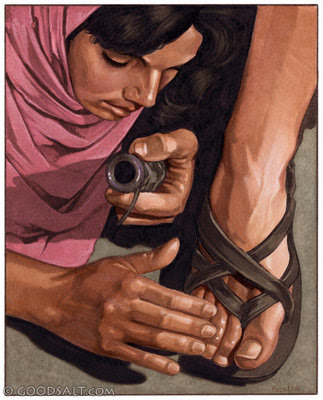
Mary of Bethany humbly anointed Jesus’ feet with expensive ointment, and “the house was filled with the fragrance of her perfume” (John 12:3). It was her sacrificial, extravagant gift that was the real fragrance in the room. And just as Jesus foretold, the memory of her tiny gift has spread like a fragrance across the earth wherever the gospel is preached. (Matthew 26:13).

There has long been a sweet smell in Dauphin County, Pennsylvania. It is chocolate. Milton Hershey, an early 20th century businessman, made a fortune on his chocolate business, especially with the iconic foil-covered “Hershey Kisses.”


His generosity to the community was as pervasive as the scent of chocolate. Hershey built homes, parks, schools, public transportation and an orphanage, to name a few of his philanthropic gifts (www.hersheystory.org). The goodness lingers on even to this day.

Pope Francis’ recent visit to Iraq has left a pervasive effect on the peace process between rival faith communities in the Middle East. Peacemaking through simple acts of conversation and respect can spread a scent of hope and reconciliation like nothing else.

Be the aroma of the knowledge of Christ where you live and have influence. Be the one to give generously, the one who crosses lines of division to extend welcome and kindness. Be the one who is willing to humbly engage in small tasks out of great love for Christ.

When you emulate Christ, even in small, sacrificial ways, God notices and people will notice. The aroma will be unmistakable, and people will gain a knowledge of God like nothing else. Never underestimate the power of the aroma of Christ-like actions.