Thursday, January 7, 2016

Big Picture


On our recent family vacation to Austin, Texas, we drove 23 hours southwest to the home of my mother-in-law.  This was our first long road trip in a very long time and in the past we have used paper maps.  This time we used computer-generated technology that was far more efficient. 

The best part about it was that you could zoom in on an area and see particular street corners, restaurants and gas stations.  Then this same technology enabled us to zoom outward and see the entire map of the United States and that pencil-thin blue line that went from PA to TX in the space of 3 inches.  Seeing the big picture was helpful to get an idea of how far we had come and how far we had left to go. 

When I think of “big picture” I think of the civil rights movement and its most famous leader, Dr. Martin Luther King, Jr.  Dr. King lived in a time and a place in history that was specific to the cause of civil rights in the United States and the elimination of Jim Crow laws that had long created an unjust disparity between people of color and Caucasian people.  However, King also saw the big picture that is as big as all of humanity. 

In his “Letter from the Birmingham Jail” Dr. King wrote, “Injustice anywhere is a threat to justice everywhere.  We are caught in an inescapable network of mutuality, tied in a single garment of destiny.  Whatever affects one directly, affects all indirectly.” 

That takes in a lot of landscape!  It includes racial justice, socio-economic justice,  gender parity, disability rights, civil rights for people in the LGBT community,  equal rights for people of various religious beliefs, and humanitarian rights for people who are migrants.  The big picture pulls everyone into the equation, and it puts a huge responsibility on those who have the world’s privileges to see the necessity to work toward leveling the playing ground for everyone’s best interest.

In Parker Palmer’s New Year’s Eve blog “5 New Year’s Revolutions” (Onbeing.org, December 30, 2015) he calls for a “revolution” against “the fantasy that a few of us can live secure, private lives while ignoring our complicity in conditions that put many others at mortal risk.”  According to Palmer, fifty percent of the world is malnourished and 68 percent lives on only $2 per day.  Seeing the big picture of poverty and injustice calls us to zoom in on local, practical justice work. 

To honor Dr. King’s vision of justice for all on his birthday, and in the spirit of our denomination's observance of Human Relations Day on Jan. 17, ponder what you can do to help create equity in this world, through your words and deeds.  Be like the big-picture-thinker John Wesley who saw the entire world as his parish. Take a look at how far we’ve come and how far we have yet to go to see that everyone has the same freedom and rights in this world.

Then step into that big picture yourself. Find places where you, your gifts and your Christian faith and values might fit. See what's there, what's not there, and how you can help close some gaps, build some bridges and make crooked places straight.

Remember, just as maps change over time, the big picture in which we all live, love and learn as children of God is not yet finished taking shape.  And as 1 John 3:2 tells us, "it doth not yet appear what we shall be."


Tuesday, December 22, 2015

2016: The Year of Epaphroditis


As I ponder the events of 2015 and look forward to 2016 I give thanks to God for each one of you.  Thank you for your faithful service to the Lord Jesus and the many ways you sacrificially give of yourselves so that people might experience the love of God.  Thank you also for the many Advent, birthday and Christmas greetings I have received and for your prayers and support.

As we anticipate another year of life and service to God I call you to consider making 2016 the “Year of Epaphroditis.”  During December I have been studying the letter of Paul to the Philippians, and no matter how many times I have read it there is always something new and fresh in the Word that informs our present time. 


Epaphroditis was sent by the Christians in Philippi to visit Paul, who was in prison for preaching the Gospel.  In those days a person in prison was not afforded daily rations of food.  The only sustenance came if someone from the outside brought in food and money. 

Thursday, December 17, 2015

From Horror to Hope

Photo by Beats Advisor
There is a horror movie out this Christmas known as “Krampus.”  According to Wikipedia “Krampus has its roots in Austro-Bavarian, German-speaking alpine folklore.”  It is a horned, anthropomorphic figure who, during the Christmas season, brutally punishes children who have misbehaved. 

This movie is not on my holiday must-see list, as I don’t have the stomach for horror movies in general, nor one about an evil side to Christmas in particular. 

Christmas is about love from God that came down to earth with the intent to not punish but save us from our misbehaving.  I prefer a depiction of the baby Jesus in a manger surrounded by adoring shepherds and mysterious international visitors from the East. That's a must-see story.

However, if you study both the Matthew and Luke Gospels Christmas does have a very unpleasant side, one that is as current as today's morning news.  The true facts of Christmas call us to respond to the Christ’s nativity in ways that go beyond seasonal giving to the poor, special worship in our churches and festive gatherings with friends and family.

Jesus was born into an oppressed people.  The Jews were under the occupation of the Romans. His birth in Bethlehem (and not back home in Nazareth) had a lot to do with the Roman government wanting to ascertain just how much the Jews could be taxed through a mandatory census.  Still today, many of the world’s wealthy use their power and influence to oppress the poor and the powerless.  As I reflect on the Global Climate Summit in France, I am concerned about the many vulnerable tiny islands that stand to lose everything if global warming continues to rise.  It is clear that rich nations are oppressing poor ones by abusing the earth’s natural resources and by valuing profits over human existence.

Wednesday, December 2, 2015

Push Back, Lean Forward


“It’s beginning to look a lot like Christmas,” the song tells us. At least that’s true on store shelves heavily stocked with Christmas gifts and decorations for sale. And beyond the look, there’s the dubious sound of Christmas for some: “Cha-ching, cha-ching.”

A continuous string of commercials over the next month will ring with the same message: “Buy, buy now, and buy more!”  The onslaught of ads that started long before Thanksgiving, Black Friday and Cyber-Monday will continue long after, with hefty credit card bills arriving close behind.
But the church has a unique opportunity to show and share with people the true meaning of this season of Advent and Christmas and to model respectful, creative kinds of gift-giving and celebrating. Paul says in the letter to the Romans, “Do not be conformed to this world, but be transformed by the renewing of your mind, that by testing you may discern what is the will of God, what is good and acceptable and perfect. “ (Romans 12:2)  

How will you have a Christ-filled Christmas this year?  You don’t have to be conformed to the patterns of this world, but you can instead push back against its “care-less” commercialism. Why not emulate the star that guided wise men, and set a shining example of a more excellent way for the world to follow?  Here are a few thoughts:


1. Observe a Holy Advent


Advent is the beginning of the church calendar and it begins four weeks before Christmas. During this time the church ponders the coming of Christ: past, present and future.   It is also a time to look within.  The best way to prepare for Christmas is to lean forward by exercising the spiritual disciplines of prayer, meditation, fasting, study of the Scriptures, tithing, worship attendance, Holy Communion and devotional reading.  Ask God to reveal the things that you need to change in your life.  Get involved in a Bible Study at church or in your community.  Don’t miss a single Sunday of worship.  Faithfully give of your means to help the poor.

Thursday, October 29, 2015

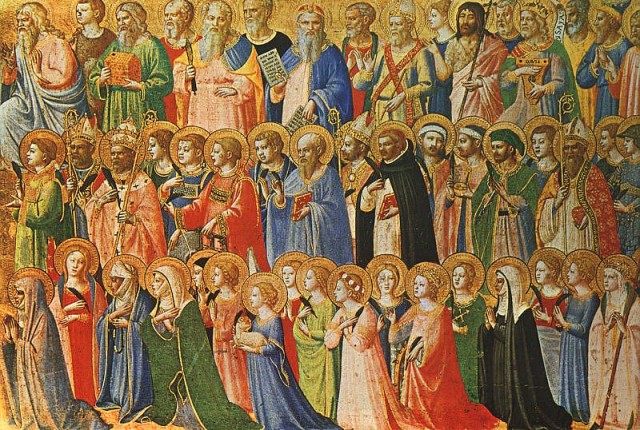
An All Saints Prayer


We thank you Lord, for the lives of those who gave their lives to you. The world does not see them as wise. But you know that the wisdom of the world is foolishness.

Thank you for those who freely offered their lives to you. They offered their family, fortune and fame. They expended their lives as a gift in Jesus name.

We thank you Lord for your prophets and for their words of truth and love. Thank you for those who fought for justice for all. They stood up for human need even in the face of persecution and suffering. They teach us that in the end justice prevails.

Thank you for saints remembered, for those we never knew, and for your church and all its members.

Use our lives for transformation that we might bless the poor and lift the burden of oppression in this world. Help us be the saints you seek for today, serving you, saving lives and making disciples of Jesus Christ for the transformation of the world.

-- Bishop Peggy A. Johnson

Thursday, October 22, 2015

In Praise of the Emmaus Walk Movement


In 1986 I attended my first Emmaus Walk as a pilgrim on Weekend #37 in the Northern Virginia Community.  That community gave birth to the Maryland Emmaus Community, and from that time on I was involved in the movement regularly as a team member, sign language interpreter and sponsor. 

There was hardly a season that I wasn’t heading off to New Windsor, Maryland, for another Emmaus Walk weekend.   Every weekend was unique.  God moved in powerful ways in the lives of the men and women who attended these retreats. 

Many, many members of the Deaf congregation I served went as pilgrims and later as team members.  We even had an entire Deaf Emmaus weekend when the entire leadership team was made up of totally of Deaf leaders. 

There are Emmaus Communities literally all over the world, including the Eastern PA and Pen-Del Conferences.
           
This retreat movement had its origins in the Roman Catholic Cursillo retreats in Spain.  Its intent was to form Catholic leaders.  The Emmaus Walk is a United Methodist version of this retreat with the purpose of forming Christian leaders and deepening the discipleship of Christians. There are separate weekends for women and men. 

On the first Easter night, as recorded in the Gospel of Luke, chapter 24, Jesus walked with two disciples who were walking to the town of Emmaus.  They were downcast about the news of Jesus’ death and did not realize that the risen Jesus himself was walking with them on the road. 

The Emmaus Walk retreat is like a little walk with Jesus for three days.  Christians gather for talks, small group discussion, communion, singing and praying.  The team leading the event and the wider Emmaus community spend many hours preparing for these weekends, which they also cover with intensive prayer.

Thursday, October 1, 2015

Being true 'Christ-bearers' in search of peace

When I was a child in elementary school we proudly sang, “In 1492 Columbus sailed the ocean blue.” There were assemblies and plays and words of praise for Christopher Columbus, who we learned “discovered America.” While the claim of discovery is a dubious one, he was indeed a brave explorer. He sailed west across an ocean that many believed would send one off the edge of a world that everyone knew was flat.

His name “Christopher” means “Christ bearer,” and part of his goal was to bring Christ to the lands he hoped to explore. He was an entrepreneur who was able to get funding for his expedition from the Spanish crown. He made not only one voyage but four, and he faced enormous hardship, dangers and political intrigue.

Much later in my life I traveled to the Dominican Republic with a mission work team that taught Bible studies at a Deaf School in Santo Domingo. While visiting the island we took a tour of the history museum that spoke much about the history of the island. There we saw evidence of much cruelty and sadness.

The Taino people, who were living in Hispaniola at the time of Columbus’ arrival, were forced into slavery. Over 98 percent of the nearly 3 million native peoples died from the labor regime and war of this time period. (History of the Indies, New York: Harper and Row, 1971). Sadly this was the lot of many indigenous peoples at the hands of European explorers who traveled to the Americas in the years that followed.

Human rights violations abound on this planet we live on. It is hard to go anywhere and not notice the abusive way humans treat each other, especially those who are deemed “less than” or different. Humans abuse one another for wealth, power and sometimes even for the cause of religious superiority.

Jesus called for us to love one another and treat our brothers and sisters as we would like to be treated. It is that simple. It is that hard.

As some prepare to celebrate Columbus Day on October 12, let us all be educated about the whole picture of global exploration across vast canvas of the world's history. Let us learn and acknowledge with repentance grievous sins committed against indigenous peoples and also live in such a way that everyone can have respect and dignity in this world.

Let us call that second Monday of October “Indigenous Peoples Day” instead, and as true "Christ bearers," seek to live and move gently on this earth in loving peace with all of God’s people.