Wednesday, September 26, 2018

History Revisited

“Forget the former things;
do not dwell on the past.
See, I am doing a new thing!
Now it springs up; do you not perceive it?
I am making a way in the wilderness
and streams in the wasteland. (Isaiah 43:18-19, NIV)
Every October when I was in grade school we sang the same song: “In fourteen hundred and ninety-two, Columbus sailed the ocean blue.” I learned about this brave sailor, who challenged the thinking of the time that the earth was flat and if one went too far west they would fall off the map.

I marveled at his tenacity. When he could not get Italian supporters for his voyage, he went to King Ferdinand of Spain and his wife, Isabella. (I especially liked hearing about Isabella since most of my history lessons in school had very few women of prominence. Betsy Ross sewing a flag in Philadelphia was the only other woman I remember.)

I was taught that Columbus “discovered” the new world and brought Christ to the heathens. I actually wrote a newsletter once at my first parish saying that the name “Christopher” meant “Christ-bearer” and that he was spreading the faith to those who had never heard.

Then I went on a mission trip to the Dominican Republic and visited a large, modern museum of history, where I learned of Columbus’ brutality and the genocide of the indigenous Taino people. He instituted slavery and engaged in horrific acts of inhumanity.

According to an article in the Philadelphia Tribune (9/2/18), “Council Must Stop Celebrating Columbus Genocide,” by Michael Coard, “the atrocities of Columbus were so bad that Governor Francisco De Bodadilla arrested him for his many crimes and sent him back to Spain in shackles.” So much for my “Christ-bearer.”

Friday, September 14, 2018

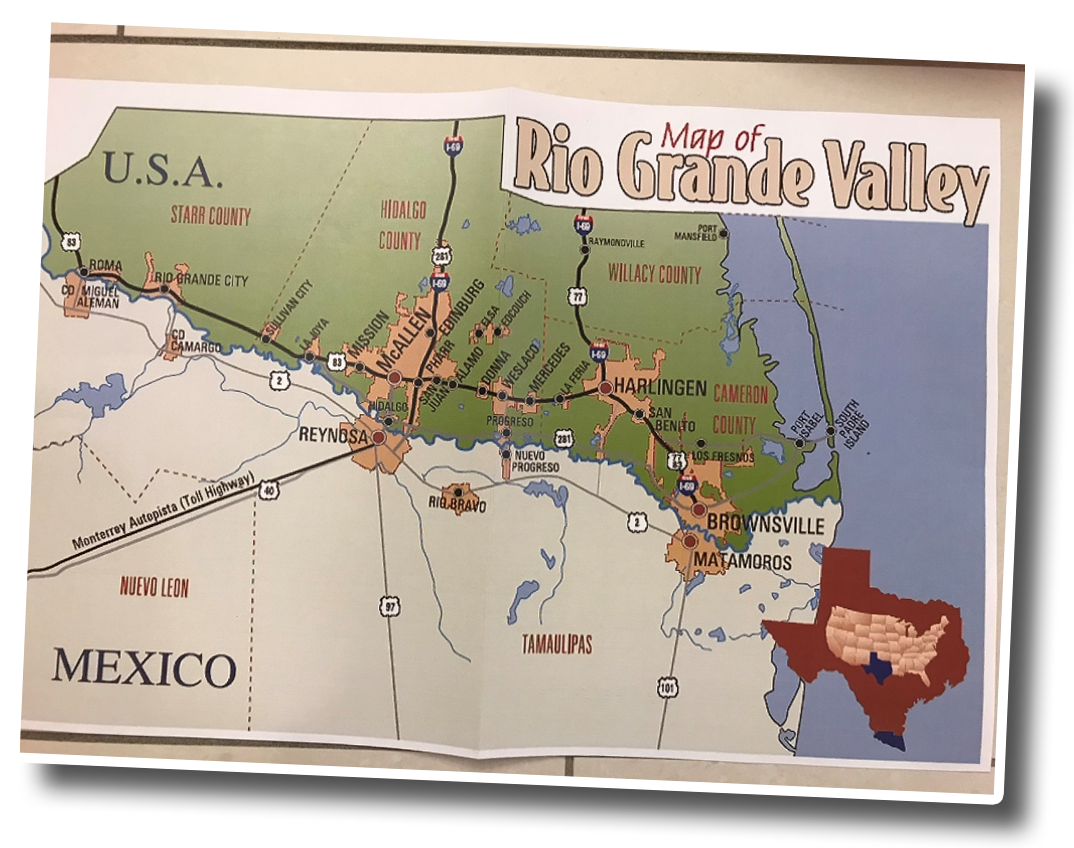
Postcards from McAllen, Texas:  An Immersion in Immigration Realities

A tour provided by the General Board of Church and Society, Bishop Robert Schnase and support  personnel from the Rio Texas Annual Conference – August 22-24, 2018

By Bishop Peggy Johnson*


McAllen, Texas, is located in the Rio Grande Valley and it borders the country of Mexico. It is one of the poorest areas in the United States.  The average income is $34,000 and 29 percent of the people have no health care services.  This is a place where many people cross the border into the United States, and the dynamics of this are highly complex. United Methodists are found in this area, serving and ministering with the poor.


Bishop Robert Schnase, who serves in the Rio Texas Annual Conference, explained that the church strives to find safe places and spaces for migrating people to be processed and engaged, to offer compassion and civility, to build relationships, to teach people about the border experience and to be constantly in prayer. Radical hospitality is the always the goal.

Wednesday, August 8, 2018

A Place at the Table


The United Methodist Association of Ministers with Disabilities met at Gallaudet University for a three-day conference for the purpose of education, advocacy and support (August 1-3, 2018). The theme was “Taking Our Place at the Table: DisABILITY Leadership Academy.”

The event included a number of speakers: the Rev. Stephanie Remington from Wesley Theological Seminary’s Lewis Leadership Center; the Rev. E. Michelle Ledder from the General Commission on Religion and Race; the Rev. Jackson Day from the General Board of Church and Society; and the Rev. Anthony Hunt from the Baltimore-Washington Conference Board of Ordained Ministry.

Back, Left to right: Rev. Ruthann Simpson (Pen-Del), Rev. Dave Goss (EPA), Rev. Bill Downing (Pen-Del), and Rev. Paul Crikelair (EPA). Front: Bishop Peggy Johnson.

Leadership development was the key component of this event; and the group strategized about how to promote more opportunities to be in leadership and inclusion in the UMC. People with disabilities, even those who are ordained or commissioned, often find themselves talked about but not present at the table.

Jesus understood the importance of table ministry. Much of his ministry included gatherings around meals and tables. It seemed like he was always doing radical acts of inclusion at the tables where he sat.

Thursday, July 26, 2018

Turning as delight


In 1848, Elder Joseph Brackett, Jr. (1797-1882) a member of a sect known as the Shakers, located in Alfred, Maine, wrote the words and the tune to “Simple Gifts.”


‘Tis the gift to be simple, ‘tis the gift to be free, ‘tis the gift to come down where we ought to be.

 And when we find ourselves in the place just right, t’will be in the valley of love and delight.   

When true simplicity is gained, to bow and to bend, we shan’t be ashamed,
To turn, turn will be our delight, till by turning, turning, we come ‘round right.” 
1

This was originally one of the dance songs of the Shaker sect, whose full name was the “United Society of Believers in Christ’s Second Appearing.” Their founder was a prophetic figure known as Mother Ann Lee. 
The group began in Europe (first France and then England) and eventually moved to the New York in the 1700’s.  The Shakers were basically Christian in their beliefs, following the teachings and lifestyle of Jesus. They lived together in communities with a strict rule about celibacy, and they held all property in common.  The movement swelled to 19 communities across northeastern parts of the United States in the 1800’s; and at its heyday they had more than 6,000 community members.  

Monday, June 11, 2018

World Refugee Day – June 20, 2018

The United Nations' (UN) World Refugee Day is observed on June 20 each year. This event honors the courage, strength and determination of women, men and children who are forced to flee their homeland under threat of persecution, conflict and violence. Some communities dedicate an entire week that includes World Refugee Day to encourage people to think about the lives of refugees and the human right to a secure place to that one can see as “home”. (www.timeanddate.com/holidays/un/world-refugee-day )


By Bishop Peggy Johnson

Last December in my
New Year’s video statement and a related article, I declared 2018 to be the “Year of the Migrant.”  There are more than 65 million displaced people living in our world today; and we, the people of God, have a mandate to show them love and hospitality:

“Do not neglect to show hospitality to strangers, for thereby some have entertained angels unawares.” (Hebrews 13:2)

“For I was hungry, and you gave me food; I was thirsty, and you gave me drink; I was a stranger, and you welcomed me.”   Matthew 25:35

“When a stranger sojourns with you in your land, you shall not do him wrong. You shall treat the stranger who sojourns with you as the native among you, and you shall love him as yourself, for you were strangers in the land of Egypt: I am the Lord your God.”  Leviticus 19:33-34

Tuesday, May 29, 2018

Dwelling in Unity


“Behold, how good and pleasant it is when brothers and sisters dwell in unity. It is like the precious oil on the head, running down on the beard, on the beard of Aaron, running down on the collar of his robes!  It is like the dew of Hermon, which falls on the mountains of Zion!  For there the Lord has commanded the blessing: life forevermore.”  Psalm 133

I have always found this tiny psalm to be curious.  The image of sacred oil poured on God’s priest in such volume that is runs down his beard and onto the collar of his holy vestments does not exactly sync with my idea of unity. Get the Kleenexes! Dew on Mt. Hermon also is a puzzling analogy, this gentle water that covers an entire mountain!  What they both have in common is a sense of pervasiveness.  The oil and the dew are in abundance and they both are symbols of the Spirit which hovers consistently over the face of the earth and among all people. 

Unity is like that. When people are living in harmony with one another it covers everything that has been divisive, it gets into the crevices of partisan debate and intellectual and ecclesiastical pride. The result of unity is abundance and provision for all.  Psalm 133 says it is a blessing and it leads ultimately to everlasting life.

Friday, May 11, 2018

United Methodist Women touched my life


In the fall of 1978 I was an M.Div student at Asbury Theological Seminary in Kentucky.  But I wondered some days if I had heard God right about this call to ministry. 

My District Committee of Ordained Ministry had put my ordination interview on hold, so I could be interviewed again. I had no role models at the seminary for women in ministry leadership. Only the librarian was a woman. All the other leaders else were men, white men, except for an Asian professor who taught Greek and New Testament.

Then came word of the Consultation for United Methodist Clergywomen in Dallas, Texas, in January 1979. I wanted to go so badly, but money was an issue. So going to Dallas was a clearly a pipe dream. That was until the United Methodist Women of my home church (Lansdowne UMC in Baltimore) stepped up to the plate and sent me the money to attend the consultation. 

It was life-changing and inspirational. It gave me the courage to keep following my call, as I saw capable, bodacious clergywomen preaching and leading with grace and skill.  Those faithful women of Lansdowne will never know just how much it changed the course of my ministry.